Understanding Accessibility and Medical Travel Support with Red Funnel
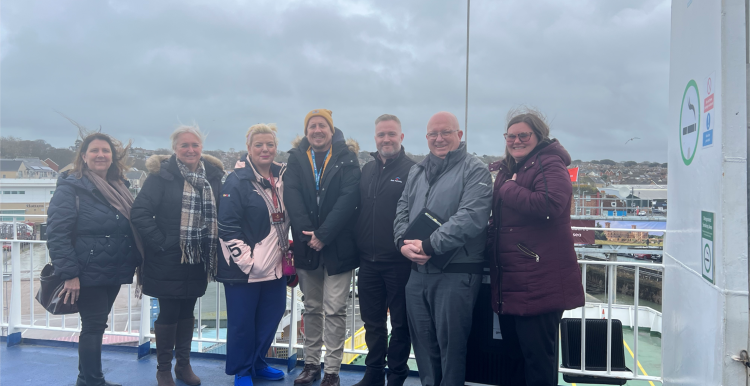
During the visit, Healthwatch representatives met with Red Funnel staff from across operations, accessibility, and customer services to explore current practice, ongoing challenges, and future plans.
Key findings
Accessibility built into day-to-day practice
Red Funnel staff described accessibility as a core part of their operational approach, rather than an additional service. This includes awareness of both visible and hidden disabilities, and an emphasis on staff discretion to support passengers when individual needs fall outside standard processes.
Several accessibility improvements have been made in recent years, including high-contrast seating and flooring on Red Jet vessels to support passengers with visual impairments, and the provision of a Changing Places toilet at the Red Jet terminal in Southampton. Staff also highlighted the importance of clear, calm communication, particularly during boarding, busy sailings, or disruption.
Red Funnel staff complete specific accessibility training, including accredited training from the National Autistic Society, and spoke about the importance of experience and culture in helping staff respond appropriately and confidently.
Support for medical and health-related travel
Staff demonstrated a strong awareness that many Isle of Wight residents rely on ferry services to access mainland healthcare. Medical travel was described as a significant and ongoing part of Red Funnel’s passenger profile, often involving anxiety, fatigue, time pressure, or uncertainty.
A number of measures are in place to support people travelling for health reasons, including:
- Flexible travel arrangements when passengers are discharged early from hospital
- Discounted travel for NHS and private dental appointments
- Free access to the Signature Lounge for passengers travelling for cancer appointments (or the option to remain in vehicles by prior arrangement) This is subject to availability, although it generally will be available, if there is a pre booked event in there or it’s at capacity, availability can not be guaranteed.
- Free travel for carers through the Project Carer initiative, where an access card is held
- Free desensitisation trips for passengers with travel anxiety
Staff also confirmed that ambulances are prioritised, including empty return journeys, and that ferries may depart early when blue-light transfers are required.
Medical equipment is available onboard, including defibrillators, evacuation chairs and emergency medication, and staff are trained to respond if a passenger becomes unwell during the crossing.
Community partnerships and wider support
Healthwatch also heard about Red Funnel’s wider role in supporting community transport and access to healthcare. This includes:
- Providing space and free travel support to the Daisy Bus, a volunteer-led service transporting patients between Southampton accommodation and hospital appointments
- Funding the Blue Star bus service in Southampton, providing free onward travel
During the visit, Healthwatch spoke with a Daisy Bus volunteer driver and heard positive feedback from a passenger using the service to travel to University Hospital Southampton.
Booking, information and awareness
Red Funnel staff acknowledged that one of the biggest challenges is awareness — many passengers are not fully aware of the support, flexibility, and discounts available to them.
There is a dedicated accessibility section on the Red Funnel website, including a sensory guide video of the ferry experience. Red Funnel has also produced printed leaflets outlining accessibility and medical travel support, which have been distributed to GP practices, dentists and pharmacies, with a view to wider distribution through healthcare settings.
Work is also underway to align ferry services more closely with national passenger assistance systems used by rail operators, to improve joined-up support across multi-stage journeys.
Consistency and future development
Staff recognised that accessibility challenges differ between vessel types. Red Jet vessels are newer and more easily adapted, while car ferries are older and present additional constraints. Red Funnel noted that future fleet development will allow for improved accessibility features.
Operational challenges were also discussed, including pressure during busy sailings and issues around hospital discharge timing, which can affect onward travel plans.
Despite these challenges, staff consistently emphasised a culture of flexibility and support, summarised by one comment shared during the visit:
“Our default setting is to help.”
Healthwatch Isle of Wight found the visit to be open, informative and constructive. Red Funnel staff demonstrated a genuine willingness to listen, reflect, and improve, and welcomed independent feedback.
Healthwatch Isle of Wight thanks the team at Redfunnel for facilitating this visit and looks forward to ongoing communication to share the experiences of Isle of Wight residents using this vital travel link.
Healthwatch Isle of Wight will continue to work with ferry operators and healthcare partners to ensure that the lived experiences of Island residents travelling for health and care are heard and used to inform service improvement.